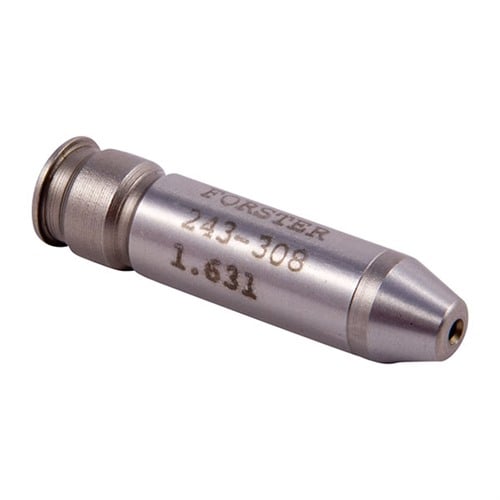
FORSTER 7.62 MATCH GAUGES Reviews & Ratings
Reviews Summary
The Forster 7.62 Match Gauges are well-constructed and serve crucial safety functions for AR builders, but many users find gauge readings unclear due to poor labeling. Their limited range raises concerns for existing barrels, with users suggesting a more comprehensive gauge set for nuanced assessments. Overall, they're useful, but better options may exist for varied applications.
What Reviewers Are Saying
Product Quality
75%
Reviewers frequently praise the construction quality of Forster headspace gauges, noting their essential role in ensuring safe rifle assembly and functioning. The robustness of these tools is highlighted, especially in relation to their importance during the building process of ARs.
Usability and Readability
50%
A significant concern among users revolves around the difficulty in identifying the type of gauge due to faded markings and lack of color coding. This issue detracts from the overall user experience, as customers often find themselves confused while trying to determine which gauge they are using.
Functionality
60%
The gauges are acknowledged for performing a critical safety function in the context of chamber headspace checking. Users emphasize that having the correct gauge functionality is essential, especially when building ARs. The reviews suggest that while the Forster gauges are useful, they may not fully accommodate existing barrels without additional options.
Value for Money
40%
While the gauges are considered high-quality, some reviews question their value due to their limited functionality in broader applications. Users are concerned that the price may not justify the narrow uses of the product, leading to considerations for purchasing alternative or more comprehensive gauge sets.
Recommendation for Improvement
30%
Some reviewers recommend improvements in labeling and usability features, like including clearer markings or color coding. This feedback indicates a desire for enhancements that would make the gauges more user-friendly and accessible, ultimately enhancing the buying decision for potential customers.
An absolute necessity for building an AR
This Forster GO Headspace Gauge is a nicely constructed product that performs an often ignored, but very important function. If your bolt carrier group locks into battery against this gauge (the smallest of the three sizes), you are good to go. This is an absolute necessity if you are building an AR.
Absolutely essential for a safe build
This Forster Field Headspace Gauge is a nicely constructed product that performs an often ignored, but very important function. If your bolt carrier group locks into battery against this gauge (the biggest of the three sizes), you have an unsafe chamber headspace and should not shoot your rifle until is it fixed. The only downside is the price, because its a very limited function tool. Bottom line, you need this tool(along with Go and NO-GO gauges) if you are building an AR.
An absolute necessity for building an AR
This Forster NO-GO Headspace Gauge is a nicely constructed product that performs an often ignored, but very important function. If your bolt carrier group locks into battery against this gauge (the middle of the three sizes), you may have an unsafe chamber headspace and should try the larger FIELD gauge before shooting your rifle. If you are planning to build an AR, this tool is a must.
More useful than Foster NO-GO gauge
The SAAMI limit is actually 1.4736 so this 1.4696 gauge may prove to be more useful as a NO-GO gauge than a FIELD gauge in many instances (manufacturers often chamber to 0.002" plus over SAAMI mins and this gauge is SAAMI min plus 0.006). The alternative Brownells (Foster) FIELD gauge checks the true SAAMI max limit ("FIELD") of 1.4736 and permits 0.004 more headspace than this gauge. For further reference, the Foster NO-GO gauge is 1.4696 and only 0.003" above SAAMI min headspace and the Foster GO gauge is at the SAAMI min limit. In my experience, most AR bolts will close on the Foster NO-GO gauge and this "FIELD" gauge may actually be a better test for "NO-GO," unless all your barrels are custom-chambered! The best solution for checking headspace, post-chambering, is the full set of 11 Foster gauges offered by Brownells. It provides 0.001" resolution over the entire 1.4636" to 1.4736" SAAMI range, which includes any 5.56 specs and limits too. (5.56 headspace specs all lie withing the SAAMI min to max range.)
Good when chambering but that's all
In studying the prints for many 5.56 and 223 chamber reamers and the SAAMI 223 Rem spec, I discovered that headspace gauges and chamber reamers are all over the map. This Forster NO-GO gauge appears check a rather arbitrary point within the SAAMI min to max headspace spec range so one can't draw much of a conclusion based on a gun failing a check with this NO-GO gauge. More specifically, the min to max SAAMI headspace spec spans 0.010 inches. The Forster GO gauge checks the bottom limit of the SAAMI spec and the Brownells (Forster) FIELD gauge checks the upper limit. Various NO-GO gauges fall in various places with respect to 5.56 and 223 Rem specs, but these intermediate gauges (including 5.56 gauges) all lie between the SAAMI 223 Rem min and max headspace limits. The problem is this Forster NO-GO gauge checks only 0.003" above the min SAAMI spec. I've learned that barrel manufacturers often chamber their barrels 0.002" longer the SAAMI minimum (the manufacturers use SAAMI min + 0.002" as THEIR mininum manufacturing spec), due to the dangers posed by "tolerance stackup" of parts and insufficient headspace. Given that the Foster NO-G0 gauge is only another 0.001" longer than these barrel manufacturers' min chamberings, it is common for a bolt to close on this Foster NO-GO gauge. While the Foster NO-GO gauge provides a sensible limit for custom chambering new barrels, its usefulness is very limited for checking existing barrels where a safety check can be accomplished with only a GO and FIELD gauge set. Given where most barrels are headspaced, a NO-GO gauge close to the middle of the SAAMI range would be more useful. Even more useful is Brownells ".223/5.56 Match Headspace Gauge Set. It can be used to fully assess the headspace of an existing barrel.
regret buying
These gauges are difficult to read what type of gauge it is.the type is so faded and there is no color codeing I spend too much time fiddling with trying to figure out under a bright light and magifying glass if im holding a GO,NOGO or field gauge. Other than that they work.I wish I would have bought gauges that have the easy to read color bands .