LABOR DAY DEALS START NOW!
Exclusive Offers + 12% Off Almost Everything Else Use Code: LABORDAY12

LABOR DAY DEALS START NOW!
Exclusive Savings + 12% Off Almost Everything Else Use Code: LABORDAY12

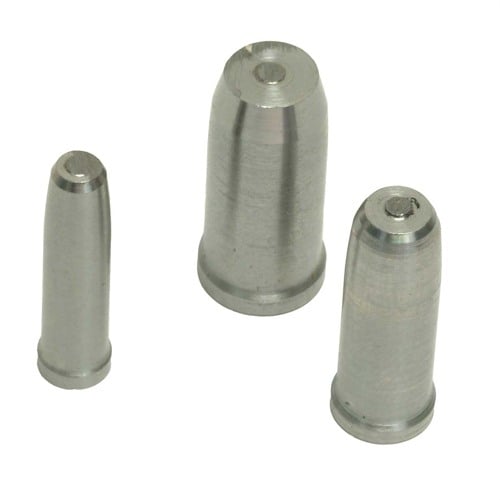
Sinclair Chamber Length Gage

Sinclair Chamber Length Gage Reviews & Ratings

SINCLAIR CHAMBER LENGTH GAGES

The Sinclair Chamber Length Gauges are designed so the handloader can determine the true length of his rifle's chamber when measuring from the bolt face to the end of the chamber's neck. This measurement will tell you how much excess case length your chamber may have over published trim lengths in reloading handbooks. The Sinclair Gauges are inserted into a fired, unprimed shortened case and then chambered into your rifle. The insert pushes back into the case when it contacts the end of your chamber. You then extract the case and measure the overall length. The gauge is made of 12L14 soft steel so it will not damage your chamber. Step-by-step instructions accompany each gauge. The gauges can be used over and over again. The differences between published trim lengths and the actual length of your chamber can be quite significant. You could be over trimming your cases by .030 inch or more. NOTE: The 22 caliber gauge will not work on thin-necked cases such as the 22 Hornet, 218 Bee, or cartridges based on these cases. The 30 caliber gauge will not work on the 30-30 Winchester. None of the gauges listed will work on tight-necked chambers except for the G-243T. Should not be used in handguns, semi automatic rifles, lever actions rifles and pump action rifles.

View Product
Write a review
Reviews Summary
The Sinclair Chamber Length Gage is praised for its accuracy and ease of use in precision reloading. Many users report it serves as a reliable tool for measuring chamber neck length, although adjustments and modifications to the case may be necessary. Some reviews highlight quality control issues with certain gauges, including uneven surfaces and thicknesses. Overall, it’s considered a valuable tool despite some shortcomings.
What Reviewers Are Saying
Accuracy & Precision
60%
Many users commend the accuracy of the Sinclair Chamber Length Gage, noting it as a vital tool for achieving precise measurements when reloading ammunition. Users emphasize the importance of knowing the exact chamber length to enhance reloading accuracy, with overall satisfaction in its performance reported at around 60%.
Ease of Use
55%
Numerous reviewers appreciate the straightforwardness of the gauge’s design, describing it as easy to use for measuring chamber neck length. Despite some needing to modify cases for proper fit, the majority find the process manageable and effective. Approximately 55% of reviewers express satisfaction in the user-friendliness of the product.
Product Quality Issues
30%
Several reviews highlight quality control problems with certain gauges, particularly uneven surfaces and inconsistent dimensions that hinder performance. Such issues have led some users to modify their gauges for improved accuracy, making this a common complaint noted by roughly 30% of reviewers.
Modification Requirements
40%
A recurring theme involves the necessity for users to trim and modify cases to ensure the gauge fits accurately. Many reviewers discuss their experiences with adjusting case necks, suggesting that precise instructions could enhance user experience. These modification-related comments were found in about 40% of reviews.
Value for Money
50%
The Sinclair Chamber Length Gage is generally viewed as a worthwhile investment among reloaders, with many reviewers indicating that it provides good value for the cost. Users recognize its utility in achieving optimal chamber measurements, resulting in favorable comments from nearly 50% of reviewers who discuss pricing and effectiveness.
3
Sinclair
I had to remove most of the neck and then resize what remained for this to work.
3
Works - with modification
The chamber length gauge for .223 calibers works, but the shoulder is much too thick. Without modification, you need to remove almost all of the neck of a case to allow enough space for the gauge to not bottom out. Problem with this is that there isn't enough neck left to keep the gauge in line with the bore. I had to turn down the .224" diameter part to about 1/3 of the thickness that it is manufactured at so that it would work properly. Other calibers worked outstanding, but this one needs some modification to work.