




Things to Consider When Choosing a Suppressor
How to Choose a Suppressor
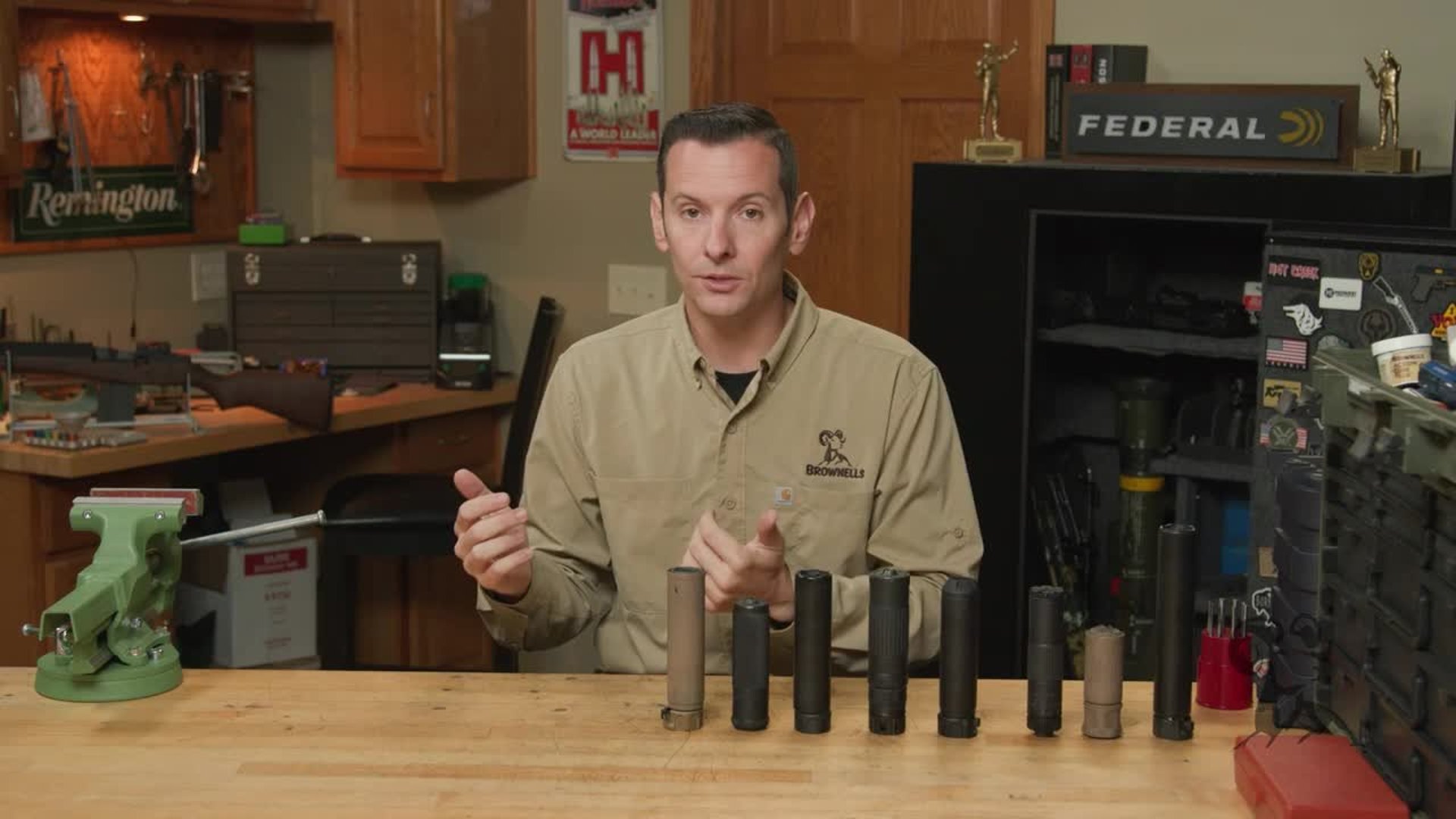
Caleb from Brownells shares his approach to suppressor selection, combining practical considerations with personal preferences. His starting point is the intended application: what firearm will use the suppressor, and which characteristics matter most for that setup?
Sound reduction is part of the decision, alongside size, weight, durability, flash reduction, back pressure, compatibility, and maintenance.
Sound Reduction and Decibel Ratings
Caleb cautions against choosing a suppressor solely by a published decibel number. Measurement equipment, microphone location, firearm configuration, and ammunition all affect how useful a comparison will be.
He also discusses the difference between sound measured near the muzzle and sound experienced at the shooter’s position. Neither a single measurement nor a nominal threshold guarantees hearing safety. Hearing protection remains important when shooting suppressed firearms.
Size, Weight, Durability, and Flash Reduction
A suppressor adds length and weight to the firearm. Caleb weighs those changes against durability and other performance goals.
For his own semi-auto setups, he places considerable value on a durable construction and effective flash reduction. His preferences illustrate why the quietest option in one test may not be his first choice overall.
Low Back Pressure and Port Pop
Caleb explains why he favors low back pressure suppressors for many semi-auto applications. He discusses how retained gas can affect the action and contribute to sound near the ejection port, often called port pop.
His broader point is to evaluate the suppressor as part of the complete firearm system. Muzzle sound is only one aspect of that experience.
Evaluating Suppressor Sound Tests
Before comparing results, Caleb recommends examining how the test was conducted. Relevant details include the equipment used and where the microphones were positioned.
Tests conducted under different conditions may not support a straightforward comparison. Consistent methods provide more useful context than isolated numbers.
Materials and Additive Manufacturing
The discussion moves to aluminum, titanium, Inconel, and other alloys used in suppressor construction. Caleb also highlights additive manufacturing and its influence on suppressor design.
Material selection relates to weight, heat resistance, durability, and the intended cartridge. He discusses how some designs use different materials in different areas to balance those demands.
Matching the Suppressor to Its Intended Use
Caleb describes choosing a suppressor for his BRN-4 and another semi-auto rifle, emphasizing durability and compatibility with the intended applications.
His selection process centers on the job the suppressor needs to perform. A lightweight hunting setup and a frequently used semi-auto may lead a shooter toward different priorities.
Maintenance and Modularity
Serviceability is another consideration. Caleb contrasts sealed suppressors with modular designs and discusses how cleaning requirements fit into ownership.
Any cleaning method needs to suit the specific suppressor’s materials, finish, and manufacturer instructions.
Using the Dead Air Mojave 9 as an example, he also discusses the option to change a suppressor’s length and how that affects his preferred configuration.
Checking Cartridge Compatibility
Caleb emphasizes confirming the suppressor’s cartridge restrictions before use. Bore diameter alone does not establish compatibility.
A suppressor suitable for one cartridge may not be approved for another cartridge with a similar bullet diameter. The manufacturer’s ratings determine the appropriate applications.
Multi-Caliber vs. Specialized Suppressors
A multi-caliber suppressor offers flexibility across compatible firearms. A more specialized model may better suit a particular application.
Caleb discusses these tradeoffs in general terms, while acknowledging that performance varies by cartridge and design. The useful comparison is between specific suppressors on the intended firearm.
Making the Choice
Caleb’s approach is to identify the application first, then weigh sound performance, handling, durability, compatibility, and maintenance together.
His preferences provide a starting point for the discussion. The final choice depends on which combination best fits the firearm and how it will be used.