




Building an affordable Hunting AR15 (One Horse)
Building an Affordable .350 Legend Hunting AR-15
Caleb is back at the Brownells bench with a new project: an affordable hunting AR-15 chambered in .350 Legend.
Brownells has built hunting-oriented AR-15s before, including previous .350 Legend projects. This time, the objective is affordability. The rifle uses budget-conscious components while still focusing on the quality and features that matter for a practical hunting rifle.
The majority of the components come from One Horse, with several carefully selected parts from other manufacturers rounding out the build.
Building an Affordable Hunting AR-15
One Horse supplies many of the standard AR-15 components used for this project. The company offers conventional AR-15 parts along with some specialty components, and Caleb selected them because of their balance between affordability and quality.
Not every component comes from One Horse. The build also incorporates parts from Faxon Firearms, Samson Manufacturing, Magpul, Die Free Co., SIG, and other manufacturers.
The idea is not simply to choose the cheapest possible component in every position. Instead, the rifle combines affordable foundational components with selected upgrades where they provide a practical benefit.
Tools for the AR-15 Build
Caleb starts with the tools used at the Brownells bench.
The setup includes the Brownells Gunsmith Vise, Brownells Magna-Tip driver set, a Vortex torque wrench, Wheeler wrench, starter punches, a Brownells lower receiver vise block, Brownells bench block, and Midwest Industries upper receiver rod and wrench.
A specialized gunsmithing vise is convenient, but Caleb points out that a more basic vise can work as long as the builder has a suitable way to securely hold the appropriate AR-15 vise fixture.
Brownells also has a more detailed AR-15 build series for anyone looking for additional information on the individual assembly procedures.
One Horse Lower Receiver
The lower receiver is a basic One Horse AR-15 receiver.
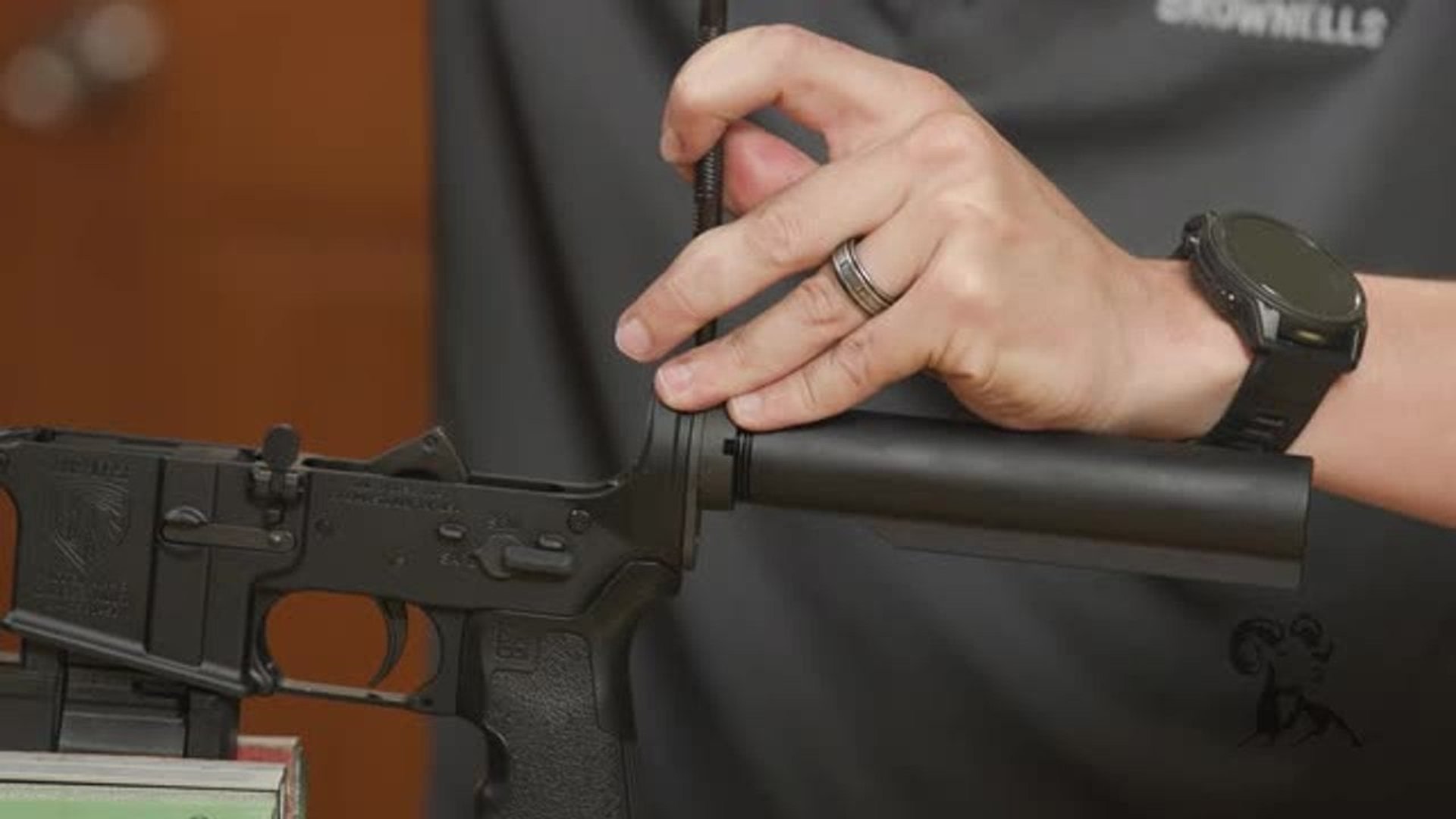
Caleb works through the major lower receiver components, including the magazine catch, bolt catch, trigger guard, pivot pin, fire control group, selector, grip, takedown pin, receiver extension, buffer system, and stock.
The lower uses a basic mil-spec fire control group rather than an expensive aftermarket trigger. That choice fits the overall goal of keeping this hunting AR-15 affordable.
Die Free Co. Grip
For the pistol grip, Caleb chooses a Die Free Co. grip.
Although an A2-style grip would reduce the price slightly, Caleb considers the Die Free Co. grip a worthwhile upgrade. It remains relatively affordable while providing the ergonomics he prefers.
It is also a grip he uses regularly even when budget is not the primary consideration.
That is a good example of the philosophy behind this rifle. Saving money is important, but a small upgrade can make sense when it significantly improves how the rifle feels or handles.
Buffer System and Stock
The receiver extension and related components come from One Horse and can be purchased together as an affordable kit.
For the stock, Caleb chooses a basic Magpul model. One Horse offers a modified mil-spec alternative that can save a little more money and includes QD sling swivel attachment points.
Caleb still prefers the ergonomics of the Magpul stock, making it another area where spending slightly more provides a worthwhile quality-of-life improvement.
With the stock installed, the lower receiver portion of the project is complete.
Building the Upper Receiver
The upper starts with a basic One Horse mil-spec receiver.
The assembly includes the forward assist and ejection port cover before moving on to the components that define the rifle's hunting configuration.
At the heart of the upper is the .350 Legend barrel.
Faxon Firearms .350 Legend Barrel
Caleb selects a Faxon Firearms .350 Legend barrel with a 16-inch length, 1-in-16-inch twist rate, and carbine-length gas system.
That combination provides the foundation for this hunting-oriented AR-15.
The barrel fits snugly into the One Horse upper receiver, and Caleb notes that the indexing pin has very little side-to-side movement. Proper component fit is something he likes to see even when working with a budget-conscious rifle.
Samson Manufacturing SXT15 Handguard
The rifle uses a Samson Manufacturing SXT15 free-float M-LOK handguard.
A free-float M-LOK handguard gives the rifle plenty of flexibility for mounting hunting accessories while maintaining a straightforward configuration.
The Samson system uses its own barrel nut and locking arrangement. As with any AR-15 handguard, the manufacturer's instructions and specifications should be followed for the particular model being installed.
One Horse Gas Block
The gas system combines a Brownells gas tube with a One Horse gas block.
Caleb emphasizes proper gas system alignment and fit during this portion of the project. The barrel used in this build is not dimpled, making careful alignment especially important.
Once the gas system is in position, the Samson handguard completes the main upper receiver assembly.
SIG TANGO-SPR Optic
For the hunting optic, Caleb selects a SIG TANGO-SPR.
The optic is already installed in its mount, so the main considerations are proper placement and eye relief for the shooter.
With the optic mounted, the rifle starts looking like a finished hunting setup.
.350 Legend Muzzle Device Compatibility
Muzzle device selection requires additional attention on a .350 Legend AR-15.
Caleb explains that sharing a common thread pattern with another caliber does not automatically mean a muzzle device is appropriate for both cartridges. Bore clearance must also be suitable for the projectile being fired.
That becomes particularly important when selecting suppressor mounts and other muzzle devices.
For this rifle, Caleb verifies the bore clearance of the selected Rearden muzzle device before using it with .350 Legend.
Always confirm caliber compatibility and follow the muzzle device or suppressor manufacturer's specifications before use.
One Horse Bolt Carrier Group
One Horse offers both nitride and nickel-boron bolt carrier group options.
Caleb chooses the standard nitride version for this build, noting that the decision between the two is largely a matter of preference for this particular project.
For the charging handle, he chooses an ambidextrous model. A standard mil-spec charging handle would save additional money, but Caleb considers the ambidextrous design a worthwhile convenience upgrade.
Again, the rifle balances affordability against practical features instead of chasing the absolute lowest possible price.
Lubrication and Final Assembly
Before final assembly, Caleb lubricates the appropriate moving components and installs the charging handle and bolt carrier group.
The buffer and spring are then installed, and the completed upper and lower receivers are joined together.
At this point, the project has become a complete .350 Legend hunting AR-15.
Function Checking the Rifle
Before heading to the range, Caleb performs a basic function check of the completed rifle.
The purpose is to verify that the controls and fire control system are operating as expected before live fire.
Any newly assembled firearm should be carefully inspected and verified before ammunition is introduced. If you are uncertain about the assembly or function of a firearm, consult a qualified gunsmith.
Duramag .350 Legend Magazines
Magazine selection can be especially important with .350 Legend AR-15 rifles.
Caleb frequently gets questions about which magazines he uses because some shooters experience reliability issues with magazines in this caliber.
His preferred option is the Duramag .350 Legend magazine.
The magazine is checked for proper fit and operation with the completed rifle before the project moves on to the next stage.
An Affordable .350 Legend Hunting AR-15
The finished rifle delivers exactly what Caleb set out to build: an affordable, practical hunting AR-15 chambered in .350 Legend.
One Horse components keep much of the foundation budget-friendly, while the Faxon barrel, Samson handguard, Magpul stock, Die Free Co. grip, SIG optic, and other selected components add practical features without turning the rifle into an unnecessarily expensive build.
The next step is taking it to the range, confirming proper operation, and sighting in the optic.
For hunters looking for an AR-15 platform suitable for whitetail deer, hogs, and other appropriate game, .350 Legend provides an interesting option, particularly where local hunting regulations make the cartridge a good fit.
If you have questions about this project or another build, leave a comment or contact the Brownells Tech Line. We'll be happy to help.