




Must Have Tools For Handgun Owners
Essential Handgun Gunsmithing Tools: What You Need on the Bench and at the Range
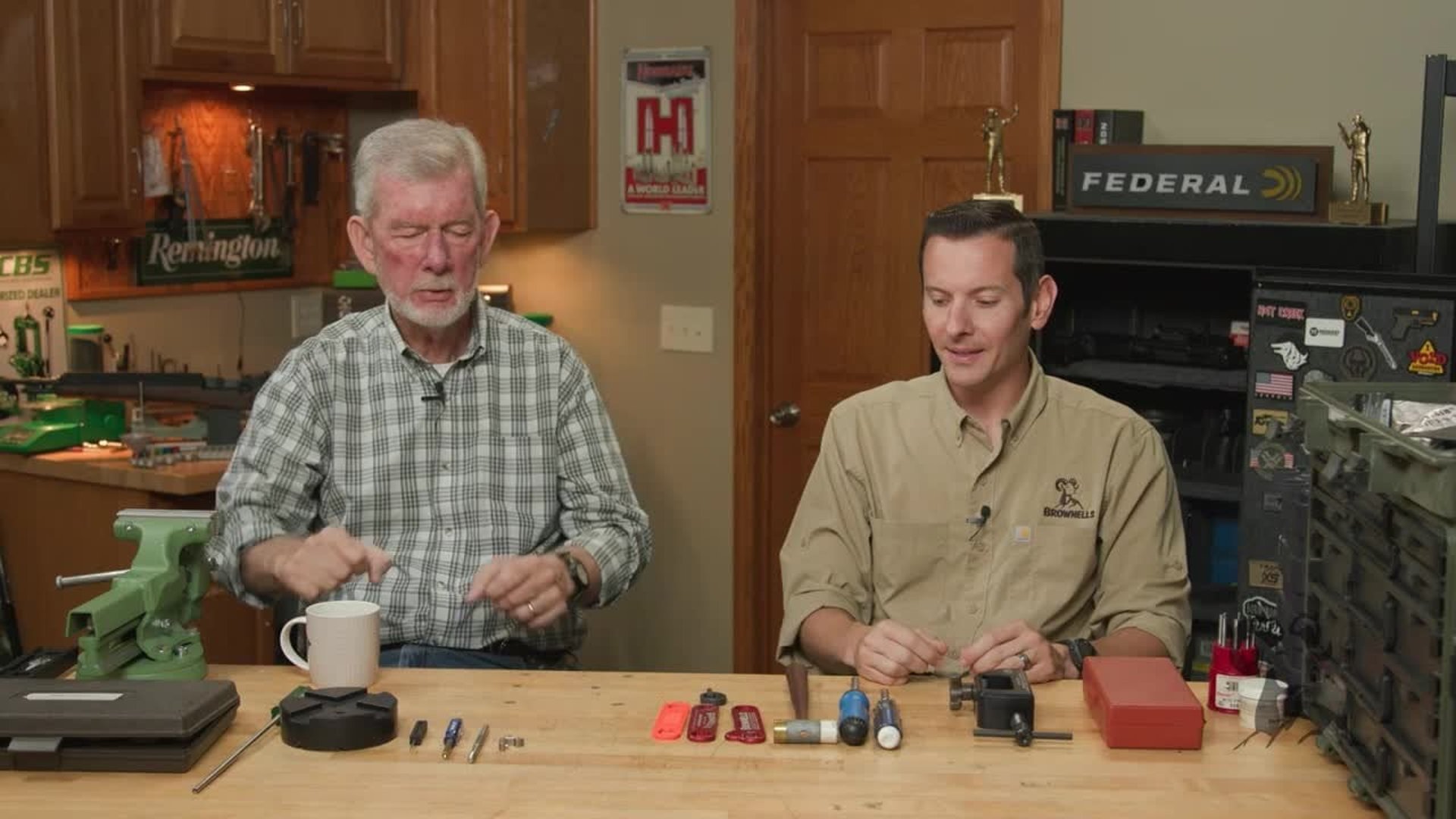
Steve and Caleb are at the Brownells bench to talk about handgun tools.
Picking tools for a handgun video can get complicated quickly because different firearms require different equipment. A revolver may call for specialized tools that have no application on a Glock®, while a 1911 has its own set of useful tools.
Instead of focusing on one handgun, Steve and Caleb cover a broad selection ranging from specialized revolver and pistol tools to basic equipment that belongs on almost any gunsmithing bench.
Revolver Range Rod Kit
One of the more specialized tools on the bench is a revolver range rod kit.
The kit includes a shaft and different caliber-specific heads. The appropriate head is used with the revolver to help evaluate the relationship between the barrel and individual chambers as the cylinder is indexed.
For someone who regularly works on revolvers, a range rod kit can be a valuable diagnostic tool.
Steve also points out that it can be useful when inspecting used revolvers at gun shops or pawn shops.
Chamber Rod
A chamber rod looks similar to a traditional cleaning rod, but there is an important difference.
Many conventional cleaning rods allow the handle to rotate independently of the shaft. With the chamber rod Steve discusses, the shaft rotates when the handle is turned.
That makes it useful for scrubbing handgun chambers and revolver cylinders with an appropriate chamber brush.
The ability to rotate the brush directly helps remove fouling rather than simply dragging the brush back and forth.
Keeping a Squib Rod in Your Range Bag
Another useful tool Steve and Caleb recommend for a range bag is a caliber-appropriate squib rod.
A squib or other bore obstruction is a situation that needs to be handled carefully. If you suspect a squib load, stop shooting immediately and verify that the bore is clear before attempting to fire the firearm again.
For anyone uncertain about safely clearing an obstruction, the best option is to have the firearm inspected by a qualified gunsmith rather than improvising at the range.
Brownells Pistol Armorer's Bench Block
A good bench block is one of the most versatile tools in the discussion.
The Brownells Pistol Armorer's Bench Block provides a non-marring work surface with features intended specifically for handgun work.
It includes flats that can support a slide, openings that provide clearance when driving pins, and a V-shaped area for supporting cylindrical components.
Caleb uses this bench block for more than pistols. It's simply a convenient surface for a wide range of firearm work.
Most importantly, it helps keep the firearm supported and away from the hard or potentially damaging surface of a workbench.
Glock® Armorer Tool
When the discussion moves to Glock® pistols, one of the simplest tools is also one of the most useful.
The Glock® armorer tool is essentially designed around the pins used throughout the pistol.
For routine Glock® work, a properly sized armorer tool makes removing and reinstalling those pins straightforward.
Brownells also offers its own handled version of the tool.
Glock® Front Sight Tool
The Glock® front sight requires a specialized tool because of the small fastener and limited working space inside the slide.
A dedicated Glock® front sight tool fits the fastener properly and gives the user enough control to remove or install the front sight without resorting to an improvised tool.
Steve notes that this becomes particularly useful when dealing with metal aftermarket sights.
As always, follow the sight and firearm manufacturers' instructions when installing or adjusting handgun sights.
Glock® Channel Liner Tool
For more involved Glock® slide work, Brownells offers a channel liner tool.
The Glock® striker channel uses a polymer liner, and the dedicated tool is designed to support the liner during installation.
The opposite end assists with removing an existing liner.
Caleb points out that a removed channel liner should be replaced rather than reused because the removal process can damage it.
Using the correct tool also helps prevent deformation during installation, which could otherwise interfere with striker movement and reliable ignition.
Glock® Magazine Floorplate Remover
Removing a factory Glock® magazine floorplate can be more difficult than it initially appears.
The Fix It Sticks Glock® magazine floorplate remover is designed to make the process easier by dealing with the retaining tabs without requiring the user to improvise with other tools.
For someone who frequently services or modifies Glock® magazines, it's a small specialty tool that can save considerable frustration.
1911 Bushing Wrenches
Moving from Glock® pistols to the 1911, Steve and Caleb start with one of the classic 1911 tools: the barrel bushing wrench.
There are several versions available, including inexpensive polymer designs and more substantial alternatives.
Steve's recommendation is simple. If you own a traditional 1911 that uses a barrel bushing, having a bushing wrench in your range bag makes sense.
A polymer wrench can provide the leverage needed while reducing the chance of damaging the pistol's finish compared with improvised methods.
Fix It Sticks 1911 Bushing Wrench
Fix It Sticks also offers a compact bushing wrench.
The small tool is easy to add to an existing range kit and can be used with an appropriate driver for additional leverage.
If you already carry a compact tool or screwdriver set, this style of bushing wrench takes up very little additional space.
MGW Handgun Sight Pushers
Sight pushers provide another level of specialization.
Steve and Caleb show an MGW sight pusher configured for a Smith & Wesson M&P.
A dedicated sight pusher can provide greater control than drifting a sight with a hammer and punch. If the sight moves slightly too far, the tool allows controlled movement back in the opposite direction.
Firearm-specific pushers can also fit the slide more securely than some universal designs.
Installing Handgun Night Sights
Sight pushers can be particularly useful when working with night sights, but they don't eliminate the need for proper sight fitting.
Steve and Caleb emphasize that the mechanical advantage provided by a sight pusher can apply substantial force.
Trying to force an improperly fitted sight into the dovetail can damage the sight or firearm.
The sight should be properly fitted before final installation, and manufacturer instructions should always be followed.
Brass and Nylon Gunsmithing Hammer
After the specialized equipment, the discussion moves into tools almost every gunsmithing bench can use.
A brass and nylon hammer is near the top of that list.
The Brownells hammer shown has replaceable brass and nylon heads.
The nylon side provides a non-marring surface for many adjustment and assembly tasks, while the brass side provides a solid striking surface for appropriate punch work.
When the heads eventually wear out, they can be replaced rather than replacing the entire hammer.
Gunsmithing Punches
A hammer isn't particularly useful for pin work without a good set of punches.
Steve and Caleb describe the hammer, punches, and bench block as a combination that handles a significant amount of basic firearm work.
The bench block supports the component, the properly sized punch works with the pin, and the hammer provides controlled force.
Quality tools also help reduce the likelihood of slipping and damaging the firearm.
Brownells Magna-Tip Screwdriver Handles
Proper screwdrivers are another gunsmithing essential.
Caleb shows several Brownells Magna-Tip configurations, including a ratcheting handle and shorter LE-style handle.
The ratcheting version can operate in either direction or be locked so it functions like a conventional screwdriver. It also provides storage in the handle for bits, making it convenient for a range bag.
The shorter LE-length handle places the user's hand closer to the work, which Steve prefers when working on firearms where maintaining control is especially important.
Why Gunsmithing Screwdrivers Matter
A hardware-store screwdriver isn't necessarily the right choice for firearm screws.
Firearm screw slots can require a more precise fit, and using an improperly fitted screwdriver increases the chance of damaging the screw head or slipping and scratching the firearm.
Brownells Magna-Tip bits are hollow-ground and available in a wide selection of sizes so the user can select a bit that properly fits the screw.
Steve and Caleb both have extensive experience using these screwdriver sets on the bench.
Building a Handgun Gunsmithing Tool Kit
Not every handgun owner needs every tool discussed in the video.
A revolver enthusiast may find a range rod kit particularly useful. A Glock® owner may prioritize an armorer tool, front sight tool, and channel liner tool. A 1911 owner should consider keeping a bushing wrench nearby.
Other tools are nearly universal.
A quality bench block, hammer, punches, and properly fitted gunsmithing screwdrivers form a useful foundation for a handgun tool kit.
From there, add firearm-specific tools based on the handguns you actually own and the work you intend to perform.
If you have a handgun tool that always stays on your bench or in your range bag, let us know in the comments. As always, if you need help selecting the right tools for your firearm, give the Brownells Tech Line a call. We'll be happy to help.