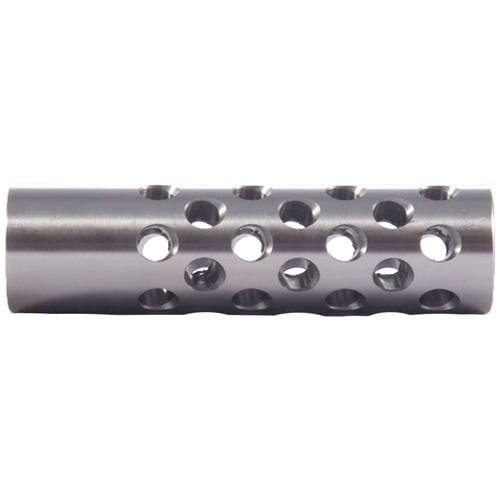
#2 MUZZLE BRAKE 22 CALIBER

#2 MUZZLE BRAKE 22 CALIBER Reviews & Ratings

Multi-port brake softens felt recoil and reduces muzzle rise. A single expansion chamber and 42 total ports, 21 on each side, angled 7° forward, provide maximum recoil control. Gunsmithing required. Comes with a .220" (nominal) diameter exit hole that must be opened up to .020" larger than bullet diameter. Can be enlarged to allow bullets up to .44 caliber. Rear exterior of comp can be machined to conform to barrel.


SPECS: 4140 steel, chrome moly (CM), in the white or 416 stainless steel (SS), satin finish. 2-5/8" (6.6cm) long. Outside diameter; #2 - .700" (17.7mm)

View Product
Write a review
Reviews Summary
The #2 Muzzle Brake performs well in reducing recoil across various calibers, with many users praising its affordability and design. However, there are concerns about inconsistent threading dimensions and safety issues in some cases. While the product generally meets expectations, checking thread compatibility before installation is advised to avoid complications.
What Reviewers Are Saying
Recoil Reduction
65%
Reviewers consistently highlight the muzzle brake's effectiveness in minimizing recoil, making shooting more enjoyable, especially for those sensitive to kick. Many have successfully installed it on various calibers, from light sporters to larger magnums, and report significant improvements.
Product Quality & Safety
50%
Customer feedback varies regarding product quality, with several reports of inconsistencies in threading and a dangerous failure incident. While most find the brake well-made, the existence of severe safety concerns raises eyebrows, suggesting thorough checks before use.
Installation Issues
40%
Multiple reviews emphasize the necessity of verifying thread dimensions prior to installation to avoid malfunction. A few customers experienced issues that required additional machining or adjustments to fit properly, highlighting the importance of careful preparation.
Affordability
55%
Many users appreciate the price point of the muzzle brake, considering it a great value compared to competitors. This affordability makes it a popular choice among both casual users and professionals who install it frequently.
Noise Level
45%
Users note the significant increase in noise when using the brake, necessitating hearing protection during use. While effective at recoil reduction, the loudness is a common downside that potential buyers should consider.
3
Muzzlebrakes.
Ordered two, one was as ordered. Second had the correct pick number on the outside of the bag but the inside was a different number with a different thread size. Now I have to send it back for exchange. .
3
Thread sizes erratic
I use a lot of these brakes and like them... most of the time. They're economical, good looking, good at reducing recoil, and well machined... except for the threads. Be sure to have your brake on hand before machining so you can accurately measure the threads first; the threads are clean and well cut, but actual dimensions on these units vary wildly. Unless you're a gambling type guy, I would not recommend buying one of these to fit pre-existing threads.
3
Threads could use some QC checking
I've learned, through experience, that it is wise to check anything and everything with female threads before I screw it on to a barrel, especially any barrel just over minimum length (eg, a 16.25" AR barrel leaves you no room to lop off damaged threads and re-cut). To that end, I have made a set of threaded stubs in various common muzzle thread specifications that I use to check silencers, brakes, etc. This way, if the female threads mess up my stub's threads, I just grab a new piece of 1144 or 4140 and make a new stub. The 1/2-28 brake wouldn't take either of my class 3A or 2A stubs for more than three threads before stopping. I saw some chips in the threads, and pulled it out. Now I got five turns into the brake. I decided that it might be best if I ran a 1/2-28 tap into the brake - I did, and it pulled out quite a bit of chips from the threads. My stub threaded in there most of the way, but not all the way, before exhibiting more signs of chips in the bottom of the threads. I ended up putting this brake on my lathe, picking up the internal threads with my internal threading tool, and taking a pass that barely made contact with the threads in order to clean out the rest of the chips that had been pressed into the threads. Overall this brake cost me 2 hours of shop time I can't bill back to a customer. At $85/hour, that adds up quickly.