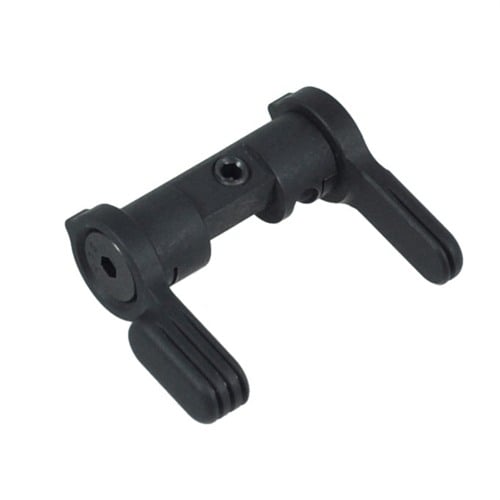
AR-15 ADJUSTABLE/REVERSIBLE/AMBIDEXTROUS SAFETY SELECTOR

AR-15 ADJUSTABLE/REVERSIBLE/AMBIDEXTROUS SAFETY SELECTOR Reviews & Ratings

Easy-to-install, reversible safety selector ensures ultra-reliable engagement and eliminates the time-consuming job of “fitting the safety” to a factory or aftermarket trigger—the perfect upgrade to accompany a J.P. Enterprises Adjustable Trigger. Eliminates the risk of damaging the trigger during fitting and shortens installation time by as much as one-third. An adjustment screw on the selector drum lets you quickly and easily set the correct trigger/safety relationship to completely block trigger movement when the selector is set to “safe.” A second screw inside the drum ensures the adjustment screw stays locked in place. Deeply grooved control pad gives positive thumb engagement even when wearing gloves, and can be installed in the standard position on the left-side of the receiver or on the right side for fast, natural operation by left-handed shooters. Includes a low-profile ambidextrous lever for the other side that adds minimal bulk while giving you the flexibility to operate the safety with the off hand in an emergency or if the strong hand is injured. Or add the JPFC-SL1 Ambidextrous Selector Lever to give your rifle a full-size safety lever on both sides of the receiver for fully ambidextrous operation. Ideal for tactical and competition shooters who may need to operate the selector with the weak hand to accommodate an unconventional shooting position.


SPECS: Steel with aluminum control pads, matte black finish. Installation instructions included.


See all of our AR15s and AR15 parts here.

View Product
Write a review
Reviews Summary
The JP Enterprises adjustable safety selector generally impresses users with its precision fit and smooth operation compared to competitors. However, it struggles with compatibility, especially with two-stage triggers like Geissele, leading to potential malfunctions. While some praised its design, others experienced significant issues requiring adjustments or alternative solutions.
What Reviewers Are Saying
Product Compatibility
60%
Many reviewers note compatibility issues with certain trigger systems, particularly the Geissele SSA trigger, leading to concerns about whether the safety selector operates correctly in various setups. This theme highlights the product's limitation as a one-size-fits-all solution, with around 60% of reviewers mentioning compatibility issues.
Installation and Fit
75%
A recurring theme across reviews is the ease of installation, with many finding it straightforward and requiring little to no fitting. Reviewers do, however, suggest that custom fitting may be necessary, especially for those seeking an ideal performance. Approximately 75% of users emphasize the straightforward installation process.
Precision and Quality
70%
Numerous reviews appreciate the machining quality and precision of the selector, indicating that it provides a smooth operation and a solid feel when engaged. This theme showcases the product's strengths in craftsmanship, mentioned by about 70% of reviewers.
User Feedback and Adjustment
50%
Feedback from users often includes a desire for adjustments and customization, particularly for achieving the desired trigger engagement without interference. Suggestions for machining adjustments reflect a need for precision, impacting about 50% of the reviews.
Overall Satisfaction
55%
While many users express satisfaction with the safety selector's performance and design, some users report challenges that prevent optimal use. This duality highlights how user needs and expectations can significantly shape their overall satisfaction, affecting about 55% of reviewers.
3
Excellent, when it fits your trigger
I installed this about a year ago when all my other internal lower parts were standard (including the trigger) and it worked perfectly. Easy installation, very nice machining (no sloppiness or excessive depth of the detent groove as you will sometimes see with a standard part) which makes for excellent, smooth feel and safety engagement/disengagement (as well as quietness). No fitting was required other than adjusting one screw. I was excited to have an ambi safety, since I am left handed, and liked that it was advertised as working with "any aftermarket trigger" (I'm quoting from their website, here), as I planned to install one down the road. After a few months of AR bliss I decided to install a Geiselle SSA trigger. I installed the trigger, cocked the rifle, switched the selector to "fire," pulled the trigger, and nothing... I swapped the JP selector for a standard one, and the trigger worked beautifully. Switching back to the JP and watching the trigger movement, I noticed that the JP was not allowing the Geissele to travel enough to release the hammer. The tail of the trigger was hitting the safety before the sear could release. This is how the safety is supposed to work when it is engaged in "safe" mode. So in effect, with this safety I effectively get "safe" mode when the selector was switched to both "safe" and "fire" modes. Pulling the safety again and visually comparing it to the standard, I could see that the JP's machined flat for "fire" was significantly shallower than the standard safety's. The difference is on the order of a couple mm, which is huge considering that this part isn't very large. It is clear that they did this because there is a transverse hole drilled in the thing (for the adjustable "safe" mode stop). I guess the designers were concerned that if they machined the thing to standard dimensions that it would be too weak. So I'm back to using the standard safety for the moment so I can actually fire my rifle. I've been thinking about machining or filing down the "fire" shelf some to see if I can make enough room for the trigger to work, but I'm not sure if that's such a good idea. It might not have enough meat there before hitting the screw hole. I'm probably going to try some competing offerings before I resort to that. I just don't see how they can claim that the thing works with all aftermarket triggers when it clearly has a travel limitation that the standard design does not. It does not work with the Geissele SSA, anyway.