



The Best Zero For Your AR15
WHAT IS THE BEST ZERO FOR YOUR AR-15
Choosing the right zero for your AR-15 depends entirely on how you use the rifle. There is no single answer that works for everyone. In this breakdown, we look at four of the most common zero distances and how they perform across practical shooting distances.
The goal is simple. Keep your impacts inside the A-zone with minimal hold adjustments.
25 YARD ZERO OVERVIEW
The 25 yard zero is commonly used but has significant drawbacks for most shooters. While your point of aim and point of impact align at 25 yards, the trajectory quickly rises above your intended target as distance increases.
At 100 yards and beyond, impacts are already outside the A-zone if you hold center. The vertical spread continues to increase before eventually dropping back down at longer distances.
This creates inconsistent holds and makes it difficult to stay accurate under time pressure. Unless you are restricted to very short distances, this zero is not ideal.
36 YARD ZERO PERFORMANCE
The 36 yard zero is one of the most versatile options, especially for red dot setups. It keeps your impacts tightly grouped within the upper portion of the A-zone from close range out to around 200 yards.
This allows you to hold center on most targets and still achieve effective hits without needing to think about elevation adjustments.
For competition shooting where targets are typically inside 300 yards, this is a strong option that balances simplicity and performance.
50 YARD ZERO WITH LPVO OPTICS
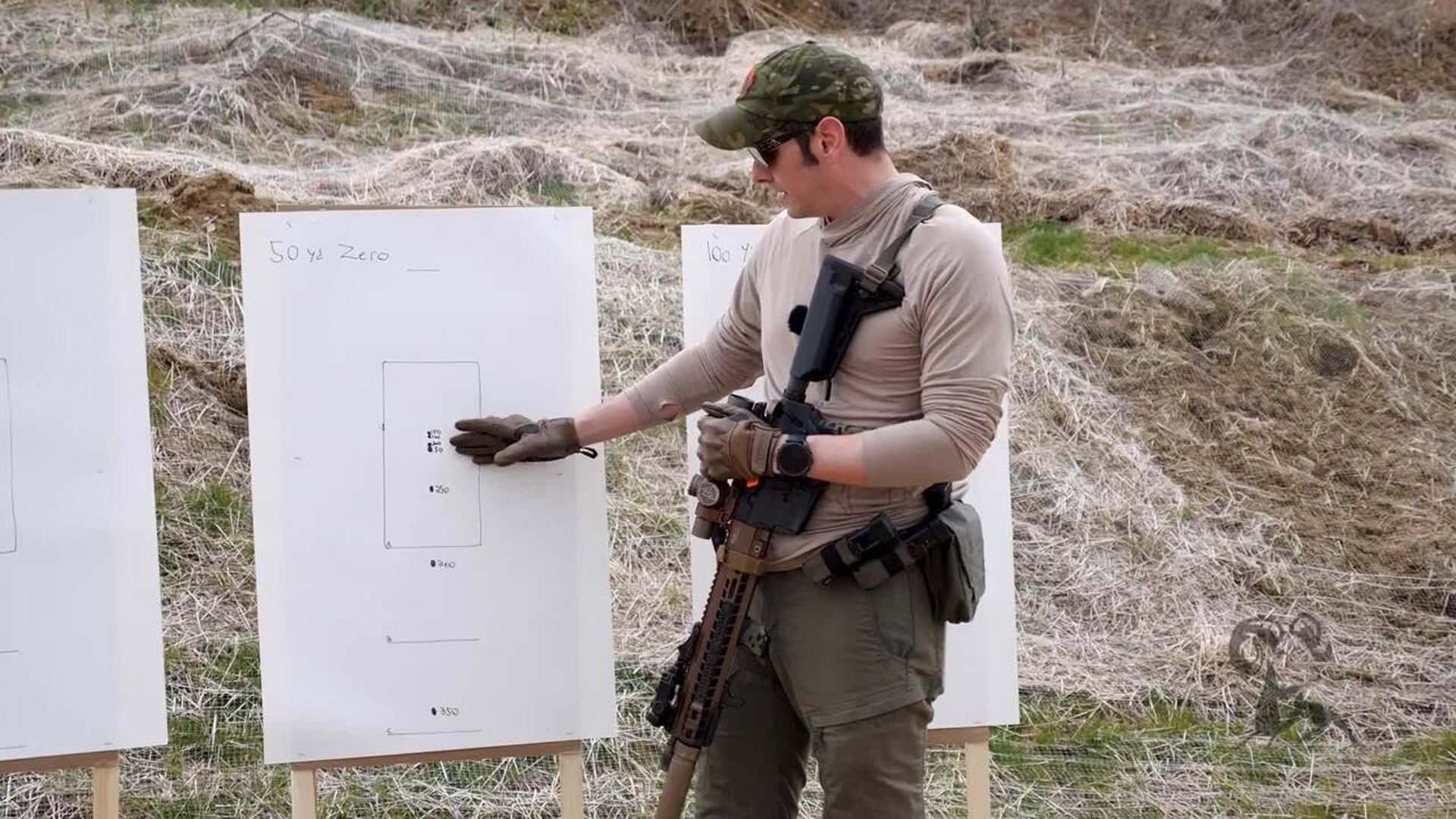
The 50 yard zero works well for rifles equipped with LPVO optics. It keeps your impacts centered through 100, 150, and 200 yards with minimal vertical deviation.
Beyond that, you will begin to see more noticeable drop. However, the holds are predictable and easy to manage using a reticle.
This zero provides a good balance between close-range usability and mid-range precision, making it a practical choice for general-purpose rifles.
100 YARD ZERO BREAKDOWN
The 100 yard zero offers the most straightforward ballistic understanding. Your point of aim and point of impact meet at 100 yards, and every other distance requires a hold adjustment below that point.
Nothing impacts higher than your point of aim. This makes it easier to build consistent data and understand your rifle’s trajectory.
For shooters using magnified optics or dialing adjustments, the 100 yard zero is often the preferred choice. It allows precise corrections and better long-range consistency.
CHOOSING THE RIGHT ZERO
Your zero should match your optic and your intended use.
For red dots and fast shooting inside 300 yards, the 36 yard zero is hard to beat. It minimizes the need for holds and keeps impacts consistent.
For LPVO setups, the 50 yard zero offers a strong balance between speed and precision.
For shooters focused on longer distances or dialing corrections, the 100 yard zero provides the most control and predictability.
The 25 yard zero has limited application and is generally outperformed by the other options in most scenarios.
FINAL THOUGHTS
There is no universal best zero. The right choice depends on your rifle, your optic, and your shooting goals.
Understanding how your bullet behaves across distance is what matters most. Take the time to confirm your zero, track your holds, and build your own data.
That is what leads to consistent hits and better performance on the range.
