



Product Spotlight: The Best Precision Rifle Gear
INTRODUCTION
Steve and Caleb lay out a table full of what looks like camping equipment at first glance, but it is really a practical gear checklist for precision rifle shooting. The common theme is stability. Precision rifle shooting forces you to build solid positions on awkward props, barricades, uneven surfaces, and sometimes in bad weather. The right support gear makes those positions repeatable.
Caleb mentions that he recently got into this style of shooting after a trip to Hat Creek in Idaho. Even without formal match experience, that kind of field course quickly shows what gear matters and what gear is optional.
SHOOTING BAGS ARE THE FIRST PIECE OF PRECISION RIFLE GEAR
Caleb starts with the one item he used the most: a good shooting bag. Precision rifle shooting is not always done from a bench or a clean prone position. You may be shooting off barricades, tree stumps, rocks, or improvised obstacles. A bag lets you create a stable interface between the rifle and whatever you are using as support.
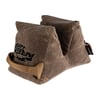
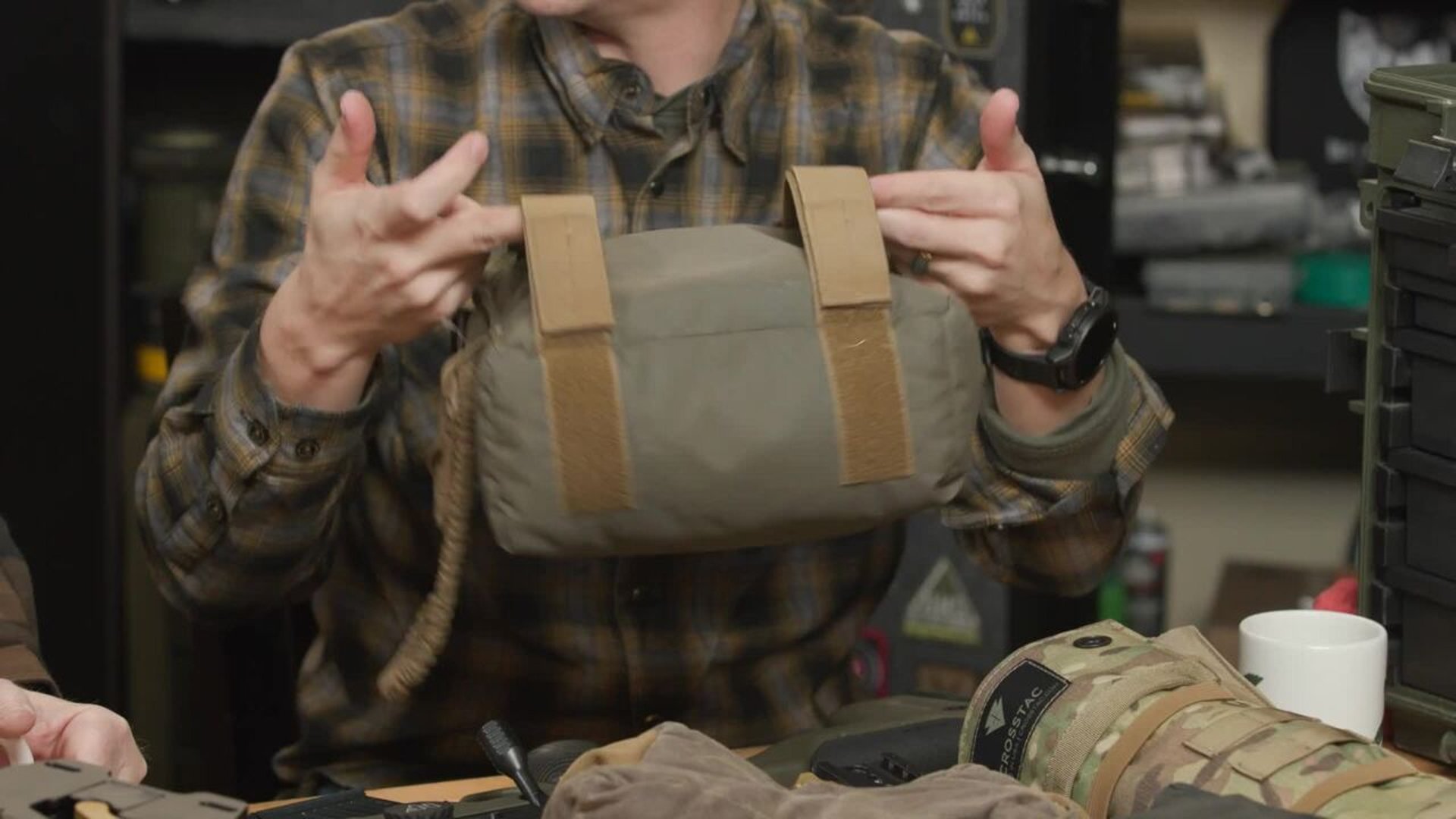
He shows Armageddon Gear bags in different weights and shapes. The key detail is that these bags are not packed rock hard. They are left slightly loose so you can squeeze them and fine-tune elevation. Used as a rear bag, that squeeze technique lets you lift or lower the reticle without drifting or wobbling.
Caleb explains another common use: instead of placing the rifle into the cutout, many shooters turn the bag sideways and rest the bag on the barricade, then lay the rifle across the top. That broad, stable surface keeps the rifle from rocking and makes it easier to call shots.
BAG MATERIALS, DURABILITY, AND FIELD OPTIONS
The bags shown include durable fabrics like waxed canvas. Caleb notes that even with heavy use, these bags tend to hold up for a long time. He also points out that fill material can be changed to adjust weight and feel.
For field use, Caleb mentions a practical trick: carry a bag empty and fill it with local material if you need support without hauling extra weight. That can be useful for hunting or field shooting where every ounce matters.
AREA 419 GAME CHANGER WITH RAIL CHANGER
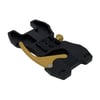
Caleb shows an Area 419 version of the Game Changer style bag built by Armageddon Gear, equipped with a Rail Changer system. The difference is that the bag attaches to the rifle using an Arca interface. In PRS-style stages, shooters often move quickly with the rifle in one hand and a bag in the other. Attaching the bag to the rifle streamlines movement and keeps support where you need it during transitions.
WHY ARCA IS TAKING OVER
Steve and Caleb talk about how the Arca system has effectively taken over modern precision rifle setups. Arca rails allow fast, repeatable mounting for bipods, bags, and tripods. If you are starting out, an Arca rail on the bottom of the rifle gives you the most flexibility.
Caleb notes that adapters exist for rifles and handguards that do not have Arca built in. For example, M-LOK to Arca adapters are common, and tripod heads with Arca clamps are widely available. The payoff is simple: easier support changes and faster stage transitions.
BIPODS AND MOUNT OPTIONS THAT MATTER
After bags, the conversation moves into bipods. Caleb highlights two common setups.
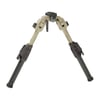
One is an MDT bipod configured with a 17S mount and an Area 419 Arca mount. This setup is built around quality machining and a solid clamp interface.
The second is an Atlas bipod paired with a QD mount that supports both Arca and 1913 Picatinny rails. That matters if you want one bipod to serve multiple rifles across different mounting standards. Caleb also notes that he has his QD lever positioned for left-handed use, making it easy to unlock, slide, and relock the bipod quickly during a stage.
He also explains a practical technique for recoil control on barricades: if your stage allows it, pull the bipod into the barricade so recoil is absorbed into the support. That helps keep the reticle on target, making it easier to spot impacts and call your own shots.
SHOOTING MATS FOR COMFORT AND WEATHER
A shooting mat is not glamorous, but it solves real problems. Shooting prone after rain or in muddy conditions can be miserable and distracting. A lightweight mat keeps you off wet ground, adds a little padding, and makes prone stages more comfortable.
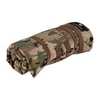
Caleb shows a CrossTac mat in multicam. It is lightweight and easy to transport, making it a good fit for range days, field shooting, and competition use.
MUZZLE DEVICE AND RUNNING SUPPRESSED
Caleb finishes with one more practical item: a muzzle attachment that supports a suppressor setup. He shows an Area 419 muzzle brake with a mounting interface designed to make suppressor attachment easier.
Steve notes that most shooters in the Hat Creek footage were shooting suppressed. Caleb agrees. Suppressed shooting is increasingly common for precision rifle work because it reduces blast, makes communication easier on the line, and helps shooters stay on the rifle.
OPTIONAL ELECTRONICS TO ADD LATER
They close by mentioning electronics that can be added later: a rangefinder and a ballistic solver like a Kestrel. Those tools become especially important on courses where the shooter is responsible for ranging targets and building dope rather than being handed distances.
FINAL TAKEAWAY
The gear on the table shares one purpose: stability. A good rifle and optic matter, but bags, bipods, and smart mounting systems are what let you build repeatable positions on real obstacles. If you are getting into precision rifle shooting, start with a quality bag, then build out your support system with Arca, a capable bipod, and a mat that keeps you comfortable in the field.